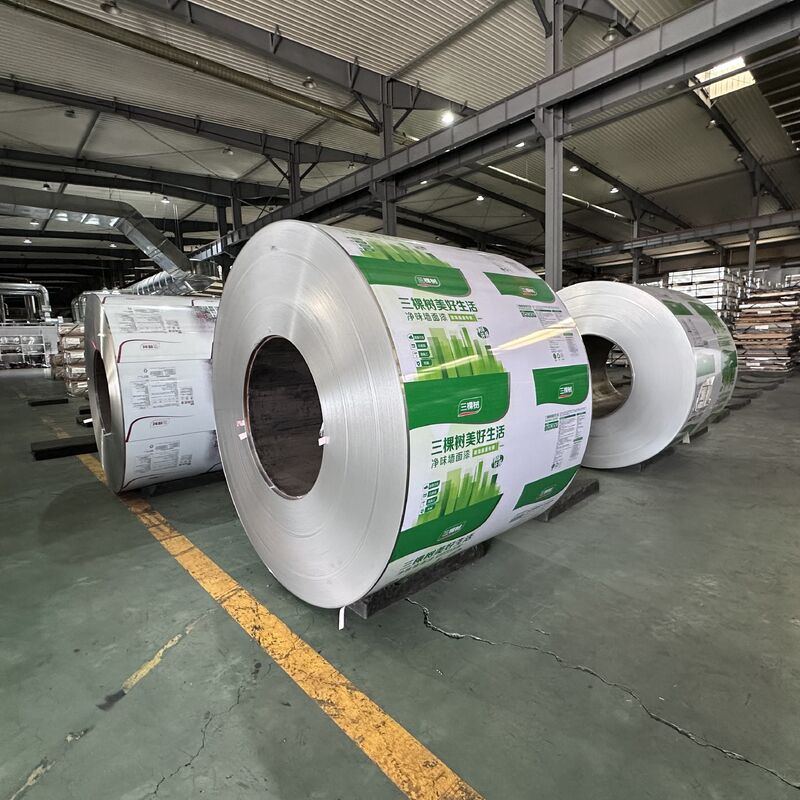
Product Introduction
In the mass production of metal packaging, material continuity and structural reliability determine manufacturing efficiency. Our precision-rolled electrolytic tinplate coil is engineered to serve as a foundational food can material for international manufacturers operating high-speed slitters, scroll shears, and multi-die stamping presses. Sourced from refined low-carbon steel vacuum-degassed substrates, these coils are subjected to uniform electrolytic tin deposition under strict current-density controls. This process creates a continuous, micro-crystalline tin coating that adheres to the raw steel, providing excellent defense against environmental exposure and internal product reactions.
The core advantage of utilizing our product in continuous roll form rather than pre-cut sheets is the significant increase in material utilization and the reduction of setup downtime on automatic production lines. Offering a versatile thickness profile ranging from an ultra-thin 0.14mm gauge up to a robust 0.45mm structural thickness, this product line accommodates diverse container designs. Whether manufacturing lightweight two-piece drawn-and-ironed (DI) beverage cans, three-piece sanitary food can bodies, or heavy-duty twist-off vacuum closures, the metallurgical uniformity of the metal ensures a consistent response to mechanical deformation. The inherent clean finish and excellent flatness of the steel prevent tracking errors during uncoiling, providing a dependable substrate for global food brands requiring a reliable barrier against oxygen, light, and microbiological cross-contamination.
Tailored Metallurgical Customization
To satisfy diverse processing and filling line layouts, our electrolytic tinplate coil program features extensive customization options. We adjust technical parameters across hardness scales, chemical coating profiles, and surface finishes to integrate smoothly into your manufacturing pipeline.
-
Broad Range of Mechanical Tempers:
We offer a complete selection of Single Reduced (SR) tempers from highly ductile T1, T2, and T3 grades (ideal for complex drawing, shaping, and deep-drawn aerosol components) to stiff T4 and T5 grades. For applications prioritizing maximum material thinning and high collapse-resistance, our Double Reduced (DR) temper selections—including DR7, DR8, and ultra-high-tensile DR9 designations—provide structural rigidity at reduced gauges, allowing for cost-effective down-gauging strategies.
-
Flexible Dimensional Variations:
With our processing range from 0.14mm to 0.45mm, manufacturers can choose the exact thickness needed to withstand specific retorting pressures. The coil widths are adjustable from 600mm to 1000mm, with precision slit tolerances down to ±0.1mm, ensuring precise alignment with your automatic slitting and scrolling lines.
-
Customized Coating Weights:
To maintain cost efficiency without compromising safety, we provide custom tin plating weights including 1.1/1.1 g/m², 2.0/2.0 g/m², 2.8/2.8 g/m², and 5.6/5.6 g/m². We also specialize in differential tin coatings (such as 2.8/5.6 g/m²), allowing you to apply a thicker protective layer to the internal surface facing acidic foods, while applying a lighter coating to the outer surface to support efficient external printing.
-
Surface Topography Control:
Depending on your lacquer application or direct lithographic printing needs, we supply multiple surface conditions. Our Bright Finish provides a smooth, specular surface ideal for high-clarity graphics; the Stone Finish features optimized micro-roughness grooves that enhance organic coating adhesion; while the Matte Finish reduces tool friction during high-speed stamping operations, extending the service life of your dies.
Technical Specifications Table
| Technical Parameter |
Engineering Values & Quality Standard Compliance |
| Material Designation |
Electrolytic Tinplate Coil (SPTE / SPCC Base) |
| Primary Industry Use |
High-performance, high-speed food can material |
| International Standards |
Fully compliant with JIS G3303, DIN EN 10202, ASTM A623, GB/T 2520 |
| Thickness Selection |
0.14mm to 0.45mm (Continuous tolerance within ±0.004mm) |
| Coil Width Availability |
600mm – 1000mm (Slitting options available upon request) |
| Inner Diameter (ID) |
Standard 508mm / 420mm with protective sleeve options |
| Coil Weight Capacity |
3.0 to 8.0 Metric Tons per individual coil package |
| Hardness Guarantee |
SR Tempers: T1 through T5; DR Tempers: DR7, DR8, DR9 (HR30T Scale) |
| Tin Coating Mass Options |
1.1/1.1, 2.0/2.0, 2.8/2.8, 5.6/5.6 g/m² or Differential Layouts |
| Chemical Passivation |
High-stability 311 (Dichromate) treatment to prevent tin-oxide growth |
| Surface Oiling Layer |
DOS (Dioctyl Sebacate) electrostatic oiling (controlled film density) |
| Mechanical Earing Limit |
Strictly controlled within Δr ≤ 0.10 to prevent uneven trimming |
 Application Scenarios
Due to its consistent roll form, high structural stability, and reliable anti-corrosion properties, this tinplate coil is widely used in global mass-production packaging sectors:
-
High-Volume Food Can Body Manufacturing:
Ideal for feed stock on continuous automatic body-welding lines. The consistent thickness profile ensures stable electrical resistance welding for three-piece cans containing vegetables, tomato purees, soups, and fruits, maintaining reliable seam integrity over a long shelf life.
-
Continuous Stamping of Can Ends and Lids:
Extensively used in high-speed multi-die stamping systems to produce standard round bottoms, sanitary ends, and easy-open lids (EOE) for tuna, mackerel, pet food, and processed meats. The material's balanced temper minimizes fracturing along score lines.
-
Drawn and Ironed (DI) Two-Piece Containers:
The ultra-thin gauges (0.14mm to 0.18mm) with high-ductility tempers allow for extreme plastic deformation, making them suitable for the wall-ironing processes used to produce lightweight beverage and milk cans.
-
Aerosol and Industrial Chemical Packaging:
Used to fabricate the three-piece bodies and domes of industrial aerosol containers, paint cans, and lubricant drums. The material provides robust panelling resistance and withstands required internal pressures without leakage.
-
Direct Lithographic Printing and Coating Operations:
The clean surface finish allows international printing facilities to uncoil, passivate, lacquer, and print continuous graphic patterns directly onto the steel roll before slitting, optimizing production workflows.
FAQ (Frequently Asked Questions)
Q1: What are the primary processing benefits of purchasing tinplate in coil form compared to traditional sheets?
A: Purchasing a tinplate coil significantly optimizes material utilization. Continuous rolls allow you to configure scroll-shearing parameters precisely to match the nesting geometry of your round dies, reducing scrap waste by up to 5% to 8% compared to square sheets. Furthermore, coil feeding eliminates the continuous loading cycles required by sheet-fed presses, enabling your machinery to run continuously, lowering labor costs and maximizing hourly can output.
Q2: How does the thickness variation of 0.14mm to 0.45mm address different packaging requirements?
A: This broad range allows engineers to choose the correct material gauge based on container volume and internal pressure conditions. Thin gauges (0.14mm to 0.19mm) are typically selected for small-diameter cans or internal components where material saving is prioritized. Intermediate gauges (0.20mm to 0.28mm) serve as the standard for high-volume vegetable and meat canning. Thicker gauges (0.29mm to 0.45mm) are used for large-scale industrial drums, specialized aerosol tops, or wide-diameter twist-off lug caps that require high mechanical rigidity and vacuum retention.
Q3: How does the electrolytic tin coating prevent rust when the coil is stored in humid environments?
A: The material features three distinct layers of protection. First, the electroplated tin layer acts as a sacrificial anode, shielding the underlying steel core. Second, an automated electrochemical 311 passivation treatment creates a stable chromium-oxide layer that resists atmospheric darkening. Finally, a controlled electrostatic layer of food-safe DOS oil is applied to block moisture contact, preventing rust formation during sea freight transport and long-term warehouse storage.
Q4: What packaging standards are used to safeguard these heavy tinplate coils during international sea freight?
A: Given the weight and sensitivity of these coils, we use a robust, vertical-axis ("eye to sky") or horizontal-axis ("eye to wall") heavy-duty packaging system. The inner diameter is protected by hardboard cores and steel rings, while the exterior is wrapped in multi-layer moisture-resistant paper and completely enclosed in a protective iron casing. The finished unit is secured with high-tensile steel bands to heavy, reinforced wooden pallets, preventing shifts, denting, or moisture exposure during ocean transit.


 Your message must be between 20-3,000 characters!