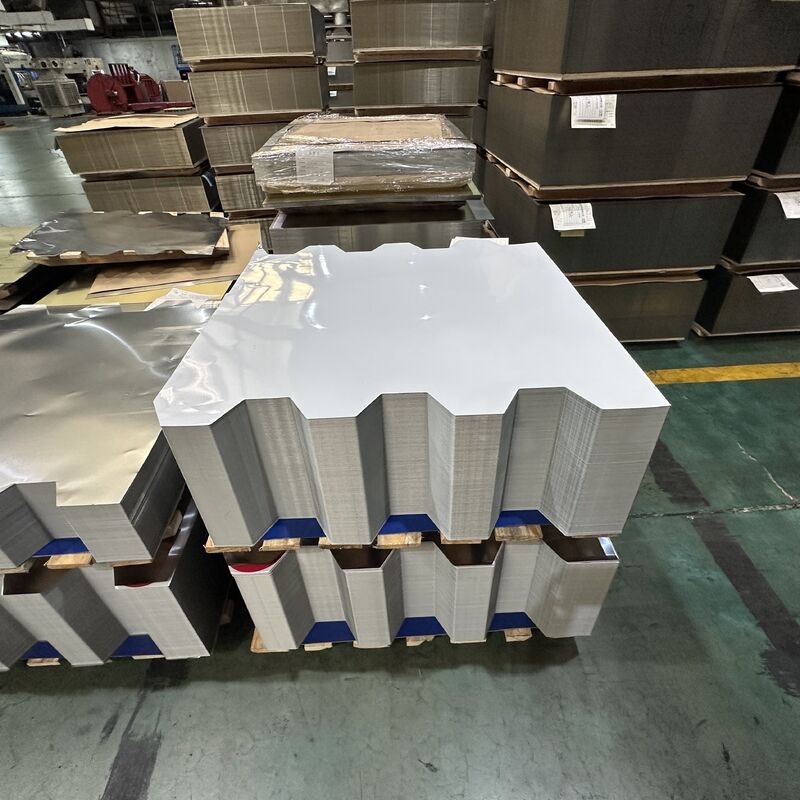
Product Introduction
In the global metal packaging industry, ensuring the perfect balance between mechanical processability and chemical inertness is critical. Our white coated tinplate sheet is engineered precisely to meet these rigorous demands, serving as a reliable food can material for modern high-speed canning operations. This product line consists of a premium low-carbon cold-rolled steel base substrate, uniformly electroplated with high-purity tin, and finished with an advanced, multi-layer organic white lacquer system. The primary function of this engineering layout is to prevent any direct interaction between the metal substrate and packaged products, preserving the sensory properties, nutritional value, and safety profile of food contents.
To provide a concrete example of our manufacturing capabilities, let us examine our highly requested T3 Temper, 0.20mm Thickness sheet with a 2.8/2.8 g/m² Differential Tin Coating. At 0.20mm thickness, this sheet delivers excellent micro-structural uniformity and high tensile stability, making it strong enough to handle structural pressures while reducing raw material weight. The T3 temper designation guarantees a well-balanced rockwell hardness rating (HR30T 57±3), which provides the ideal mechanical yield point required for precise cylindrical forming, body flanging, and clean end seaming without material fractures. Meanwhile, the white coated topcoat provides a bright, opaque background that eliminates the need for expensive base white printing coats, stream-lining the downstream lithographic branding process while establishing an unyielding barrier against atmospheric oxidation, high-humidity warehousing, and localized rust formation.
Advanced Customization & Temper Engineering
We understand that a single specification cannot fulfill all manufacturing requirements. Therefore, our white coated tinplate sheet infrastructure supports extensive technical customization across metallographic structures, mechanical dimensions, and chemical coating weights to align with your specific machinery and product lines.
-
Tailored Temper and Mechanical Performance:
Our manufacturing setup covers a wide array of Single Reduced (SR) and Double Reduced (DR) steel grades. From the highly ductile T1 and T2 tempers—perfect for deep-drawn components, complex nozzle profiles, and tight-radius closures—up to high-tensile T4, T5, and ultra-rigid DR8 or DR9 tempers. These ultra-rigid profiles are specifically designed for low-thickness, high-pressure application demands like aerosol can bodies or large-diameter closures that require maximum panelling resistance.
-
Precision Dimensioning and Surface Texturing:
Depending on your slitting and stamping machine capabilities, sheets can be customized within a thickness range of 0.15mm to 0.45mm and widths from 600mm up to 1000mm. We offer specific surface textures including Bright, Stone, Matte, and Silver finishes. A Stone or Matte surface finish enhances lacquer adhesion and reduces friction during rapid feeding cycles on automatic press machines.
-
Differential Tin Coating Weights:
To optimize cost efficiency, we provide custom coating weights from 1.1/1.1 g/m² for dry food packaging, up to 5.6/5.6 g/m² (or differential configurations like 2.8/5.6 g/m²) for severe environments. This ensures that the side of the food can material exposed to corrosive brines receives adequate protection without over-specifying the external coat.
-
Formulation of White Organic Lacquers:
The white coating system can be chemically engineered using polyester, acrylic, or specialized modified organosol resins. This allows clients to select Bisphenol-A Non-Intent (BPA-NI) variants to comply with strict food safety regulations in North America and Western Europe.
Technical Specifications Table
| Product Format |
Flat Rectangular Sheets / Continuous Slit Coils |
| Primary Industry Keywords |
Tinplate sheet / Electrolytic Tin Plate (ETP) / Food can material |
| Reference Standard Compliance |
JIS G3303, DIN EN 10202, ASTM A623, GB/T 2520 |
| Steel Core Chemistry |
MR Type / SPCC / Low-Carbon Aluminum-Killed Steel Base |
| Thickness Tolerances |
Nominal 0.20mm (Strict ±0.004mm micro-tolerance) |
| Width & Length Boundaries |
Width: 600mm - 1000mm; Length: 500mm - 1200mm (Customizable) |
| Hardness Target (T3 Temper) |
HR30T Scale: 57 ± 3 |
| Tin Layer Density |
2.8 g/m² / 2.8 g/m² (Equally distributed or customizable differential) |
| White Coating Adhesion Rating |
Grade 0 (Cross-Hatch Tape Adhesion Test per ISO 2409) |
| Coating Flexibility (Erichsen) |
≥ 6.0 mm without coating micro-fractures or delamination |
| Internal Surface Finish |
High-barrier chemical passivation treatment with anti-rust oiling |
| Current Leakage Threshold |
Average electrical current ≤ 3.0 mA per sheet unit test |

Application Scenarios
Thanks to its multi-layer barrier properties and customizable mechanical properties, this white coated tinplate sheet functions as an adaptable raw material across multiple segments of the commercial packaging sector:
-
High-Acid Vegetable and Fruit Containers:
This material is widely used for canning diced tomatoes, citrus segments, sliced pineapples, and pickled vegetables. The thick white organic layer prevents the natural citric and malic acids from etching the underlying tin layer, preventing metallic taste transfers and maintaining a long shelf life of up to 36 months.
-
Sulfur-Rich Seafood and Meat Canning:
When packaging proteins such as tuna, salmon, mackerel, corned beef, and luncheon meats, thermal processing can release volatile sulfur gases. Our specialized white lacquer formulation blocks these gases from reacting with iron, eliminating the risk of black iron sulfide stains and keeping the inside of the container looking clean and hygienic.
-
Dairy and Infant Formula Packaging:
Evaporated milk, condensed cream, and dry milk powders require high moisture protection and absolute chemical inertness. The pristine white interior coating provides an optical assurance of cleanliness and safety, preventing oxidation and preserving delicate dairy fats.
-
Dry Consumer Products & Confectionery Tins:
Ideal for stamping decorative candy boxes, tea canisters, biscuit tins, and nutritional powder containers. The external white surface serves as an excellent substrate for direct CMYK lithographic printing, delivering sharp graphic rendering without requiring a white primer base.
-
Industrial and Specialty Chemical Packing:
Beyond food, the high rigidity and chemical resistance of our T3/T4 sheets make them suitable for producing aerosol can bodies, brake fluid containers, and lubricant tins, where high burst pressure ratings and leak prevention are critical.
FAQ (Frequently Asked Questions)
Q1: What are the primary advantages of utilizing a pre-coated white tinplate sheet over standard bright-finish sheets?
A: A pre-coated white tinplate sheet provides both processing and anti-corrosion benefits. For printing operations, it eliminates the expensive and time-consuming "white coating" run on lithographic printing lines, allowing your facility to print vibrant CMYK designs directly onto the sheet. From a safety standpoint, the white lacquer layer works alongside the tin plating to create a dual-barrier system, significantly lowering the risk of rust and pinhole corrosion in highly acidic or salty environments.
Q2: How does the T3 temper rating perform during high-speed automated canning operations?
A: T3 temper represents an ideal balance for a versatile food can material. With a Rockwell hardness of HR30T 57±3, it possesses enough spring-back resistance to keep its shape during rapid mechanical transport and assembly, yet remains ductile enough to undergo smooth rolling and flanging during can body forming. This balance keeps tool wear low and prevents edge cracking or split seams, even on automated lines running at hundreds of cans per minute.
Q3: Can this white coated material withstand high-temperature retort sterilization without peeling?
A: Yes. The organic white coatings are formulated and baked at high curing temperatures to ensure deep cross-linking with the substrate. The finished sheets are fully rated to withstand autoclaving and retort processing conditions at 121°C for up to 90 minutes. Under these conditions, the white film will not blister, peel, yellow, or lose its adhesion, ensuring compliance with food safety standards throughout the thermal processing cycle.
Q4: What measures are implemented to ensure the anti-rust performance during shipping and long-term storage?
A: To protect the sheets before they reach your production line, each sheet undergoes an automated electrochemical passivation treatment that forms a microscopic oxide layer to halt atmospheric oxidation. We then apply a light, food-grade DOS (Dioctyl Sebacate) oil film. For transport, sheets are wrapped in heavy-duty moisture-barrier paper, enclosed in a robust iron guard casing, and securely strapped to fumigated wooden pallets to prevent rust or physical damage during sea freight.


 Your message must be between 20-3,000 characters!