Place of Origin:
China
Brand Name:
QuanJiang
Certification:
ISO9001
Model Number:
Tinplate Lid
Contact Us
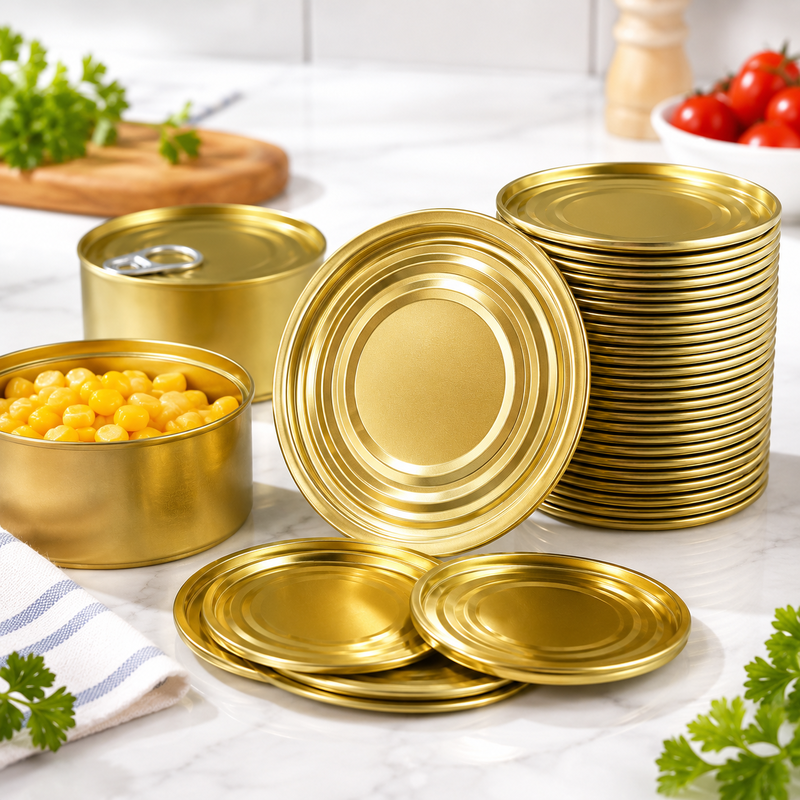
In the modern food processing industry, packaging integrity is paramount to ensuring shelf-life stability and consumers' safety. Our engineered 300# (73mm diameter) round bottom tinplate lid represents a superior solution crafted specifically for high-acid and sulfur-rich food packaging. Using high-purity electrolytic tinplate as the primary food can material, this bottom end is manufactured through advanced precision stamping and double-sided lacquer coating processes to fit seamlessly onto standard multi-piece metal containers.
With a nominal thickness of 0.18mm, this structural design achieves an optimal balance between material lightweighting and structural rigidity. It withstands the extreme internal pressure variations and thermal stresses encountered during commercial retorting and sterilization cycles. Every batch undergoes strict compliance audits to meet international food-contact safety standards, providing an impermeable barrier against oxygen, moisture, and microbiological contaminants. By optimizing the metal chemistry and organic coating adhesion, this product guarantees long-term freshness and prevents any sensory alteration of the canned contents, making it a reliable pillar for global vegetable canning facilities.
Exceptional Corrosion and Acid Resistance:
Canned vegetables often contain natural organic acids and brines that can aggressively attack bare metal surfaces. This tinplate lid features an optimized internal lacquer system that completely isolates the raw steel substrate from the contents. It passes rigorous 20% CuSO₄ immersion tests without any rust formation, ensuring that even under prolonged storage, the metal remains entirely unaffected by acidic degradation.
Superior Sulfur-Blackening Defense:
Certain vegetable varieties, such as corn, peas, and beans, release active sulfur compounds during thermal processing. If a standard food can material is poorly protected, these compounds react with iron to form unsightly black iron sulfide. Our specialized internal coating provides an active barrier that prevents sulfur penetration, passing intense 121°C sterilization tests for 60 minutes with zero peeling, blistering, or blackening.
High-Temperature Retort Stability:
Commercial sterilization requires intense heat and pressure. This round bottom end is engineered to endure autoclave conditions of 121°C for up to 30 minutes without any loss of coating gloss, wrinkling, foaming, or micro-cracking. The physical adhesion of the protective film remains perfectly intact, preserving the container's vacuum sealing properties.
Precision Mechanical Formability:
Designed with a precise disk depth of 0.60±0.10mm and consistent hook-side dimensions (≥3.07mm), this component runs seamlessly on high-speed automatic seaming lines. The excellent straightness when stacked prevents double-feeding issues and minimizes operational downtime, allowing for a perfectly airtight double seam every time.
| Technical Parameter | Specification Details & Performance Standards |
|---|---|
| Product Classification | Round Bottom End / Non-Easy-Open Can Lid |
| Core Industry Model | 300# (Industry Standard Nomenclature) |
| Exact Physical Diameter | 73mm |
| Material Base Substrate | Electrolytic Tinplate (Food-Grade SPTE / MR Type) |
| Nominal Thickness | 0.18mm (±0.005mm tolerance) |
| Disk Depth Measurement | 0.60mm ± 0.10mm |
| Hook Side Length | ≥ 3.07mm |
| Internal Coating System | Organosol / Epoxy Phenolic (BPA-NI options available) |
| External Coating Options | Clear Gold Lacquer / White Coating / Custom Lithography |
This specialized tinplate lid is widely integrated across the commercial agricultural preservation sector. Its robust barrier characteristics make it the ideal choice for sealing a vast array of vegetable products packed in different mediums:
Brine-Packed Vegetable Cans: Perfect for mushrooms, asparagus, artichoke hearts, and sliced carrots where salt solutions create an accelerated corrosive environment for standard metal closures.
High-Acid Vegetable and Tomato Products: Extensively utilized for diced tomatoes, tomato pastes, pickled peppers, and sauerkraut. The heavy-duty internal lacquer resists chemical attacks from organic acids over an extended 2-to-3-year shelf life.
Protein and Sulfur-Rich Vegetables: Specifically recommended for sweet corn, green peas, chickpeas, and mixed legumes to actively block chemical blackening during retorting.
Ready-to-Eat Prepared Meals: Suitable for canned vegetable soups, curries, and stews that undergo aggressive post-packaging sterilization, preserving both the nutritional profile and original flavor profile of the recipe.
Q1: Why is a thickness of 0.18mm chosen for this specific 73mm tinplate lid?
A: The 0.18mm thickness represents an optimized engineering threshold for a 73mm (300#) diameter closure. It provides sufficient mechanical tensile strength to prevent panelling or buckling during the cooling phase of retort processing, while minimizing overall raw material weight to help canned food manufacturers reduce transportation costs and carbon footprints.
Q2: What type of internal coating is applied to this food can material?
A: We utilize high-performance, food-safe organosol or epoxy-phenolic coatings. These formulas are specifically chosen for their cross-linking density and flexibility, ensuring that the coating does not crack or separate during the high-speed mechanical stamping of the round bottom profile.
Q3: How does this product prevent electrical conductivity or micro-leakage failures?
A: Every production lot is monitored via current-leakage testers. The structural design ensures that the average electrical conductivity per piece remains under 3.0 mA. Low conductivity indicates a continuous, flawless layer of lacquer without any microscopic pinholes or exposed iron, ensuring total defense against chemical corrosion.
Q4: Can this 300# round lid be used on automatic double-seaming machinery?
A: Yes. This component is engineered to comply with strict dimensional tolerances for disk depth and hook profile. It features exceptional stacking straightness, meaning it de-nests reliably in high-speed automatic filling and seaming machines without causing jams or mechanical faults.
Send your inquiry directly to us