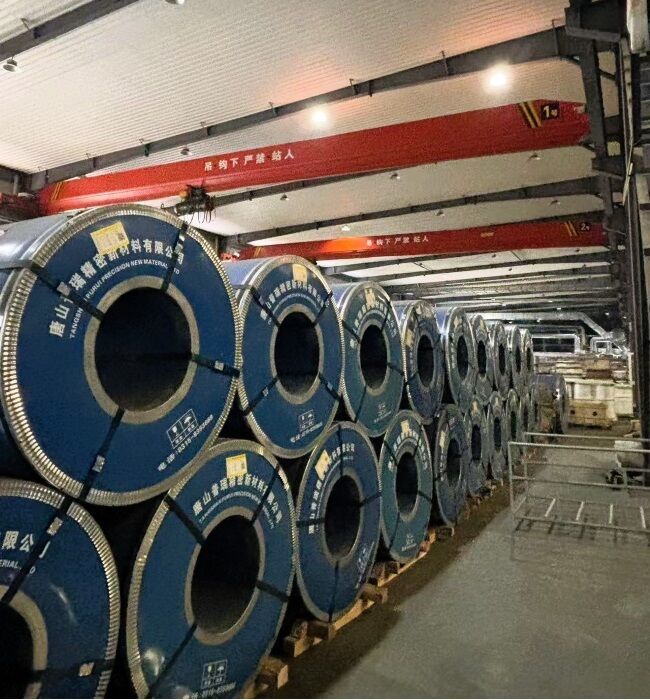
0.16mm & 0.26mm Electrolytic Tinplate Coils with Superior Paint & Corrosion Resistance
Product Description
This product line features precision-gauge Electrolytic Tin Plate (ETP) and Tin-Free Steel (TFS) coils, specifically offered in the critical thicknesses of 0.16mm and 0.26mm. Engineered for high-performance food can manufacturing, these thin yet strong materials provide an optimal balance between material efficiency and structural integrity. The core of its performance lies in the electrolytic tin (or chromium) coating, which acts as a superior, reactive base for protective paints and lacquers while delivering inherent resistance to rust, acids, and alkalis. This dual functionality makes it an ideal substrate for producing durable three-piece welded cans, draw-and-iron (DI) cans, and aerosol containers that must withstand aggressive internal contents and external environments.
Features & Characteristics
- Precision Thickness Control: Supplied in exacting gauges of 0.16mm and 0.26mm, enabling material lightweighting for cost savings while ensuring consistent formability and can strength.
- Enhanced Paint Adhesion: The specially treated surface (Bright, Stone, Matte, Silver) provides an excellent anchor for internal and external coatings, ensuring lacquers and inks bond firmly for long-term durability and vibrant printing.
- Multi-Faceted Corrosion Defense: Offers proven resistance against rust (external), and chemical attack from acidic (e.g., fruits) and alkaline food products, extending the packaged product's shelf life.
- High-Strength Material Options: Available in a wide spectrum of hardness and temper grades (T2-T5, DR7.5-DR9, TS230-TH620), allowing for fine-tuning between deep-draw formability and final can rigidity.
- Manufacturing Flexibility: Suitable for various can-making processes, including welding, stamping, and deep drawing, and can be supplied in custom slit widths and coil dimensions.
Key Advantages
Selecting these thin-gauge tinplate coils translates to direct operational benefits. The precise thickness reduces raw material tonnage and weight, lowering costs and environmental impact. The superior paintability minimizes coating defects and rejects, while the inherent corrosion resistance safeguards brand reputation by preventing can failure. Supplied in coil form, it ensures efficient, continuous feeding into automated production lines, maximizing throughput and yield.
Technical Parameters Table
| Parameter |
Specification |
| Material Type |
Electrolytic Tin Plate (ETP) / Tin Free Steel (TFS) |
| Base Steel |
MR, SPCC, Prime Grade |
| Key Thickness |
0.16mm, 0.26mm (Range: 0.15-0.45mm) |
| Coil Width |
600mm – 1030mm (Customizable) |
| Temper & Hardness |
T2-T5, DR7.5-DR9, TS230-TS290, TH415-TH620 |
| Tin Coating Mass |
1.1/1.1, 2.0/2.0, 2.8/2.8, 5.6/5.6 g/m² |
| Surface Finish |
Bright, Stone, Silver, Matte |
| Core Certification |
SGS, Mill Test Certificate |
Frequently Asked Questions (FAQ)
Q1: What are typical applications for 0.16mm vs. 0.26mm tinplate?
A1: 0.16mm is often used for lighter-weight can ends, specific components, or applications where extreme material efficiency is critical. 0.26mm is a versatile, standard gauge for the bodies of many food and aerosol cans, providing an excellent balance of strength and economy.
Q2: How does this tinplate enhance paint adhesion?
A2: The surface undergoes specific passivation treatments and can be supplied with controlled roughness (e.g., Matte, Stone finish). This creates a larger effective surface area and optimal chemical state for paints and lacquers to mechanically anchor and chemically bond, preventing peeling or blistering.
Q3: Can this material be used for acidic food products like pineapple or tomatoes?
A3: Absolutely. The tin coating provides sacrificial corrosion protection. For highly acidic contents, it is designed to be paired with FDA-compliant, acid-resistant internal epoxy lacquers, forming a robust dual-layer defense system.
Q4: What is the difference between BA and CA annealing for these coils?
A4: Batch Annealing (BA) results in a brighter, glossier surface and a softer temper. Continuous Annealing (CA) provides more uniform mechanical properties and a slightly harder temper, which is often preferred for high-speed, consistent forming in coil-fed production lines.
Q5: What quality documentation supports your material?
A5: We provide a comprehensive Mill Test Certificate with each shipment, verifying chemical composition, mechanical properties (temper, hardness), coating weight, and dimensions. Additional third-party SGS inspection reports are available upon request.



 Your message must be between 20-3,000 characters!